In a strange kind of a way, I am always a little bit excited when something goes wrong with with an appliance or device at home. Whilst of course I would prefer it if things did not go wrong (especially if they cause major inconvenience). However, on the other hand it offers an opportunity to learn about how something works and the possibility of repairing it. And also of course a chance to write about it and hopefully help someone else.
I have written about household appliances before (a dishwasher), and this time it is a washing machine. I’ve always been keen on buying quality brands with the expectation that they will last, and so far this has proved the case. My washing machine is a Siemens E14-16, otherwise known by its Siemens model number of WM14E162GB/12. I’ve had it for years, and I think it bought it in 2010.
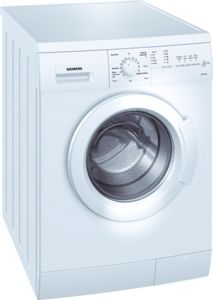
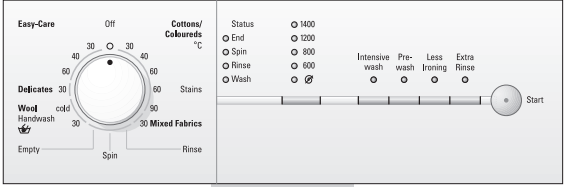
I’ve never had any trouble with it, other than the fabric softener channels get clogged up from time to time. Unblocking these was a bit of a job but that’s a story for another day. However, I tried to use it the other day, and nothing happened The front panel is pretty basic, and the only display is a few columns of LEDs. The machine wouldn’t start, and a few of the ‘spin speed’ lights were flashing.
The front panel looks like this. I was seeing the ‘1400’, ‘800’ and ‘no spin’ lights flashing:
Somewhat to my surprise I found an explanation of this in the manual:
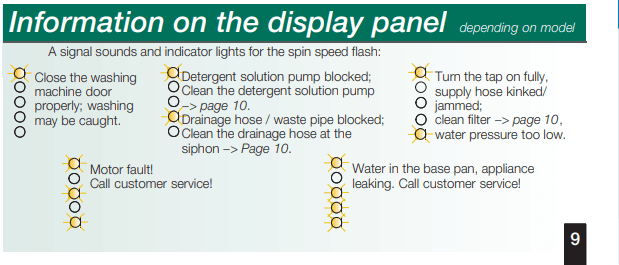
So it’s a ‘motor fault’. Rather than calling customer services, a bit of googling around revealed the most likely explanation of motor faults to be worn or damaged brushes on the motor. This isn’t the place to give a detailed explanation of how an electric motor works, but in essence there is a rotating armature which is fed current via ‘brushes’ (actually solid blocks of graphite, like pencil lead) which are usually spring loaded. They gradually wear down over time, and when they wear our they cause a lot of odd behaviour including noisy or poor running, sparks, overloads and ultimately the motor stopping altogether.
In my case I was able to reset the machine and clear the fault and it did carry on working. The reset procedure was extremely obscure and not covered in the manual. I was very glad to find it as part of a Q&A on a very similar subject here. The procedure is:
- Turn the dial to off.
- Turn it to the 6 o’clock position.
- Press and hold the spin speed selection button.
- Turn the dial 1 click clockwise (whilst holding the button)
- Release the button.
- Turn the dial to off.
This got the machine going again, but the motor sounded noisy and it seemed highly likely that the brushes were failing and this fault would be the first of many unless I did something about it.
There are a lot of guides and videos out there about how to do this, but I am going to do my own as well as there were a few pitfalls I encountered which might be helpful to others. I’ll go though the details in the next post.

 Universal Discovery Methodology
Thankyou ! This just worked beautifully, can’t quite believe it. Was desperate to get some washing done and after checking the filter and trying a few things on the internet I assumed I would be calling for help. Thanks so much for sharing.
That’s great! Thanks for letting me know
Thank you very much for the reset manual! I changed my brushes as well but I had no clue how to reset it. Until I saw your artical! Many thanks!
That’s great! I really don’t know why they have such an obscure reset procedure. Presumably this is stop mere mortals who are not Siemens engineers from repairing their machines. I have now very sadly had to retire this machine, as I started getting the same error again and upon further investigation came to the conclusion that the motor was burned out. I think the bearings were also failing as the drum had got harder and harder to turn which I imagine also contributed. I got a good 11 or 12 years out of it which I think is pretty decent given it’s been used every day in that period. I was able to replace it with a brand new but very similar model, and I’m hoping I’ll get a similar degree of use. I must say that the new one is much quieter and moves around less than the old one which is nice.