I’ve been experimenting with different light control systems for years, as I’ve talked about on here before. This has mostly been Z-Wave using Fibaro devices. These are great bits of tech, but they do have drawbacks. They are quite expensive (about £50 each) and the dimmer versions (which are needed for 2-wire installations, common in the UK and in my house) often need an additional ‘bypass’ if you are using with LED bulbs which are low wattage. This is extra expense and quite fiddly to install. However they are extremely clever, have loads of settings and options and are completely ‘stealth’ in that they work fine with normal light switches.
I’ve become increasingly interested in the Philips Hue system largely because of cost and ease of use. The bulbs are increasingly cheap especially those made by 3rd party manufacturers. For example the range of Innr bulbs:

These can be had for less than £10 each on Amazon for the plain white ones, and even the genuine Philips ones are down to about £13 now. If your room only has one or two bulbs, it feels a lot cheaper and easier to use these rather than a Fibaro dimmer and bypass plus dimmable LED bulbs which are not cheap in themselves.
You do need to have a Hue hub to get started which are not cheap, but once you have one (I bought mine as part of a starter back in a sale a couple of years ago) you can add as many bulbs as you like (although there must be an upper limit I’ve not hit it yet). The hub is well supported by FHEM so easily integrates with my other ‘smart home’ devices
So far all good, but there is one major flaw which is the switching. I like to keep all my home automation kit as ‘stealthy’ as possible, preserving normal ‘interfaces’ (ie lightswitches) or making things completely automatic. Hue doesn’t allow for this at all, and because the bulbs obviously only function when switched on at the wall, if people use the normal light switches and turn the bulbs off then you can’t turn them on again!
What they do supply are a couple of designs of battery powered remote control / wall switches. One is the ‘Tap’ :

This one has three buttons so is quite flexible, but it’s a funny shape and I don’t really like the look of it. It’s also really expensive (£50) and hard to see how to make it stealthy.
The other option is the more straightforward ‘Dimmer Switch’:

This is rather more conventional looking, and a lot cheaper (RRP of about £17). The design is quite clever, in that the buttons are held to the backplate by a magnet which means you can detach it easily to use as a remote control and it also help with fitting.
What is frustrating is that Philips don’t seem to acknowledge the switching issue, and the instructions suggest fixing the switch to the wall with sticky tape or screws. There is no mention of what to do with the existing switch, and havoc would ensue at our house if I tried to tell people not to use the ‘proper’ switch but this instead.
When I actually got the switch in and looked at it, it struck me for the first time that this had been thought of… but only for the US market. The backplate and screw fittings are clearly intended for the longer, thinner US style light switches (which have always looked odd to me):
The intention clearly is that you should remove the switch entirely, hard wire the connectors together and replace it with the Hue switch so it’s obvious which to use and it looks fine with the decor. It also removes the risk of anyone turning the light off rendering it no use for remote control.
It is very irritating that Philips haven’t produced a UK version, you feel it would be quite easy as all that would be needed is a different shaped backplate. The US ones are much narrower than the UK ones, so you can’t just fix it over anyway because it will leave a gap either side and look a right mess.
Clearly I’m not the only person to have this idea, and there are a lot of solutions out there although I’m not impressed with most of them. The most common seems to be 3D printing a frame which fits over the whole existing switch with the Hue on top. The result is a huge box on the wall, and the quality of the finish doesn’t look good. It feels like a bad hack to me, and the results I’ve seen are not impressive:
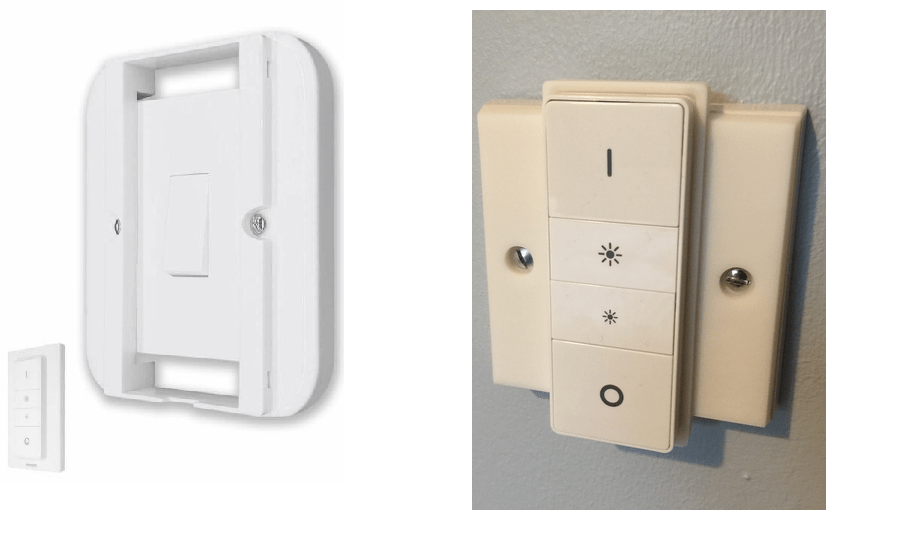
However, after a bit of digging around I have found some alternatives, because what I really want is a plate which converts from a US switch to a UK one. There are a couple of these out there, and the best one I have found so far is from Etsy:

The supplier (DFXHome) seems pretty well regarded and does a range of similar products. It also comes supplied with a connector to hard wire the switch wires. This one is specifically designed for the Hue switch and the whole plate is designed to snap in and there is a sloping profile around. The advantage of this is that it keeps the whole of the Philips supplied unit which looks much nicer. The only problem is that like all 3D printed items the finish is a bit grainy.
I’ve got one of these in now and it’s installed, and I’m really quite happy with the result. The family have got used to pressing the buttons and I’ve been able to make good use of the automation aspects, using FHEM to trigger some LED strip lights as well the main light (I’ll cover this in another post). This is how it looks, there are a few rough edges but the overall effect is good. I suspect you could sand it smooth with some fine sandpaper and overpaint it although I’ve not actually tried this.
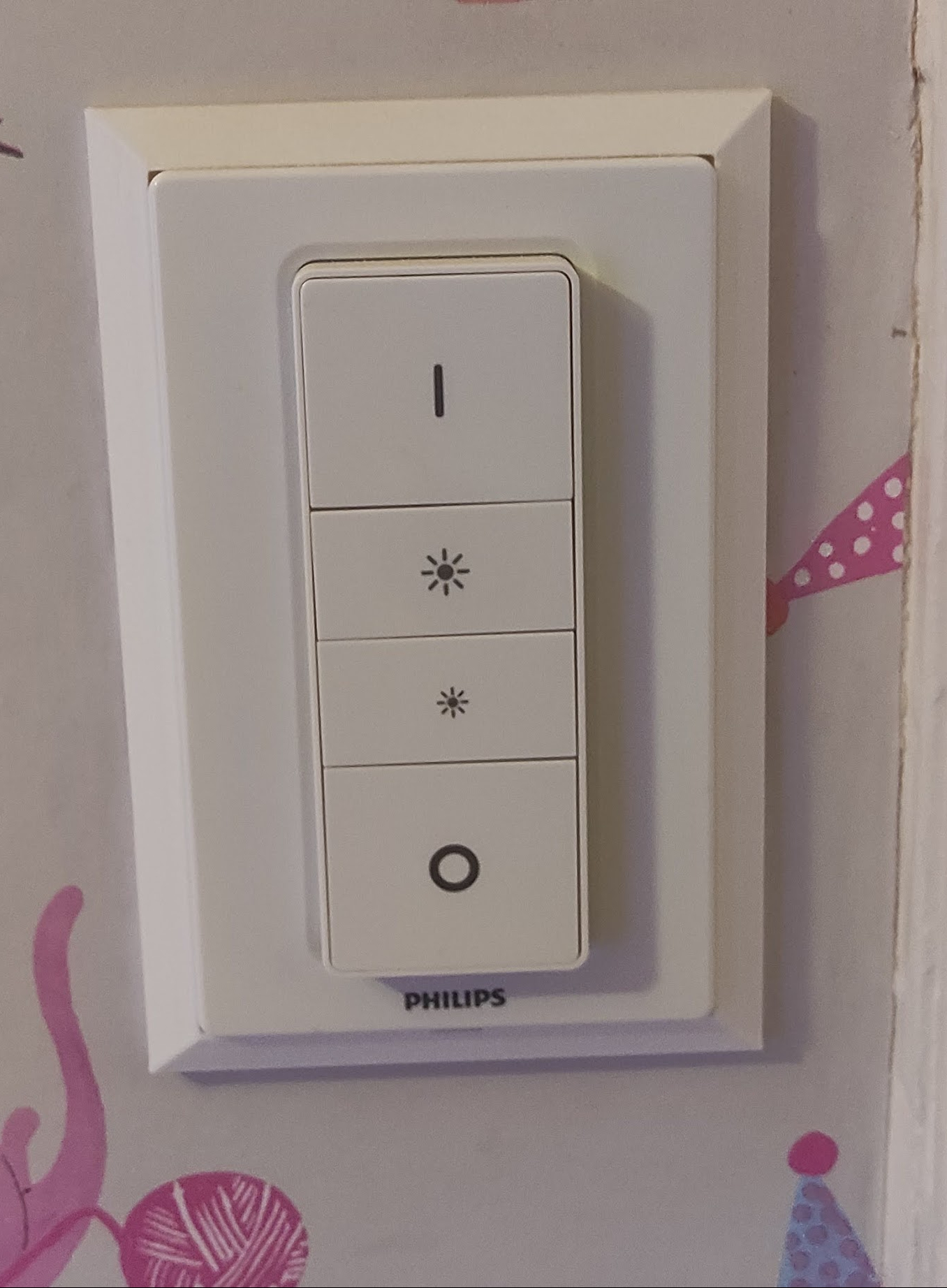
Given how successful Hue has been I really hope that Philips will produce a UK version of the back plate… but until they do this approach is the best available and I’d recommend this product.
I’m probably not going to spend much more on Z-Wave now so I think I’ll be installing a few more of these!

 Universal Discovery Methodology
You should check the Tuya family transformations, operating on Tasmota or other open source esp8266 firmware. https://github.com/arendst/Tasmota/wiki/Tuya-OTA